Generic ESP32-S3 DevKitC-1 + SX1262 module
8 MB flash, quad PSRAM. Wire the SX1262 as documented in platformio.ini (PIN_LORA_* overrides).
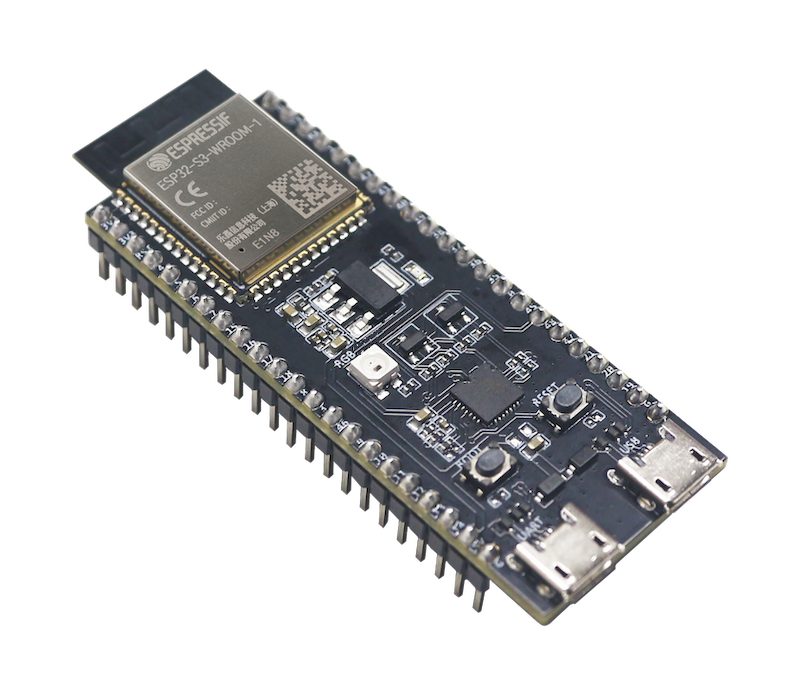
The DevKitC-1 itself; the SX1262 module is wired to it separately.
01 Hardware
| Vendor | Generic |
| PlatformIO env | esp32s3-qspi |
| Board header | src/boards/t3s3.h |
| MCU | ESP32-S3: 8 MB flash, quad PSRAM |
| Chip family | ESP32-S3 |
| Radio | SX1262 |
| Display | optional SSD1306 |
| Host links | Wi-Fi access point + station · USB CDC-NCM Ethernet · native USB console |
| Flashing | esptool can reset the chip through this port |
02 Radio
| Transceiver | Semtech SX1262 |
| Radio family | SX126x |
| As the registry states it | SX1262 |
| Default channel | 869.525 MHz · BW 125 kHz · SF8 · CR 4/5 · 7 dBm inherited from Config.h |
| SPI bus | FSPI |
Every node on a channel must agree on frequency, bandwidth, spreading factor,
coding rate and sync word. These are the defaults this build ships with; they are changed
live on the node's settings page, which prints the matching RNodeInterface block.
03 Pin map
Read straight out of src/boards/t3s3.h — every peripheral
the firmware drives on this board, and the GPIO it drives it on. A harness diagram, not a
picture of where the parts sit.
Every pin as a table, with the define it comes from
| Peripheral | Signal | GPIO | Define | Note |
|---|---|---|---|---|
| Radio | SCK | GPIO 5 | PIN_LORA_SCK | |
| MISO | GPIO 3 | PIN_LORA_MISO | ||
| MOSI | GPIO 6 | PIN_LORA_MOSI | ||
| CS | GPIO 7 | PIN_LORA_CS | ||
| RST | GPIO 8 | PIN_LORA_RST | ||
| BUSY | GPIO 34 | PIN_LORA_BUSY | ||
| DIO1 | GPIO 33 | PIN_LORA_DIO1 | ||
| DIO0 | GPIO 9 | PIN_LORA_DIO0 | ||
| OLED panel | SDA | GPIO 18 | PIN_OLED_SDA | |
| SCL | GPIO 17 | PIN_OLED_SCL | ||
| microSD | SCK | GPIO 14 | PIN_SD_SCK | |
| MISO | GPIO 2 | PIN_SD_MISO | ||
| MOSI | GPIO 11 | PIN_SD_MOSI | ||
| CS | GPIO 13 | PIN_SD_CS | ||
| Power | VBAT | GPIO 1 | PIN_BATTERY_ADC | |
| Controls & indicators | BTN | GPIO 0 | PIN_BUTTON |
04 Firmware support
What this build actually drives on this board. Where a part is fitted but left alone, the firmware's own reason is quoted underneath rather than summarised.
| Capability | State | Detail |
|---|---|---|
| Reticulum transport | driven | Path table, announce propagation, hop-by-hop forwarding |
| Wi-Fi AP + captive portal | driven | Status page, neighbours, bulletin board, settings |
| TCP 4242 + AutoInterface | driven | Stock RNS clients, zero-config discovery |
| LoRa radio | driven | Semtech SX1262 |
| Radio self-test at boot | no | Proves the IRQ line on first boot |
| RF front end | no | Driven before the radio can hear anything |
| External PA | no | — |
| Display | driven | OLED · 128×64 |
| Backlight control | no | — |
| Touch layer | no | — |
| Keyboard | no | On its own microcontroller, over I²C |
| Trackball | no | — |
| microSD | driven | Reticulum store moves onto the card when one is present |
| GNSS | no | — |
| Real-time clock | no | Seeds the system clock at boot |
| Power management IC | no | — |
| Battery gauge | driven | — |
| IMU | no | — |
| Magnetometer | no | — |
| Environment sensor | no | — |
| Sounder | no | — |
| USB networking (CDC-NCM) | driven | The node is an Ethernet link with DHCP over the cable |
| PPP over the serial bridge | no | — |
05 Bench notes
builds; wire per flags.
06 Install
Browser
Pick Generic ESP32-S3 DevKitC-1 + SX1262 module in the web flasher and click Install. Desktop Chrome or Edge, over HTTPS.
Terminal
pipx run --spec "git+https://github.com/dobrevit/RetiMesh_Node#subdirectory=tools/retimesh-flash" \
  retimesh-flash install --board esp32s3-qspi
From source
pio run -e esp32s3-qspi
pio run -e esp32s3-qspi -t upload
pio run -e esp32s3-qspi -t uploadfs